【The Work of Art】
These days, AI feels like weather.
You don't have to look for it. It finds you.
Every day, something new — faster, smarter, cheaper, or at least louder. And sure, part of it is the algorithm's fault—the better it gets at feeding me what I'll obsess over, the more I stay inside a bubble I accidentally built for myself. Like a hamster on a wheel, but the wheel is YouTube and the hamster is anxious.
Then my not-so-techy wife asked me to set up a "Lobster" (OpenClaw) for her.
That's when I knew. This isn't a tech people problem anymore.
---
Anxiety is a strange thing. You don't argue with it. You walk around it.
So I went back - to older versions of myself. Running, Soccer, Overlanding. And eventually… art.
Someone once said (I forgot who, sorry, wise person):
"When you feel stuck, go to a museum. Trade your present for human history."
I don't know if problems get resolved that way. But standing in front of things made thousands of years ago, makes your own problems feel… smaller. Picayune.
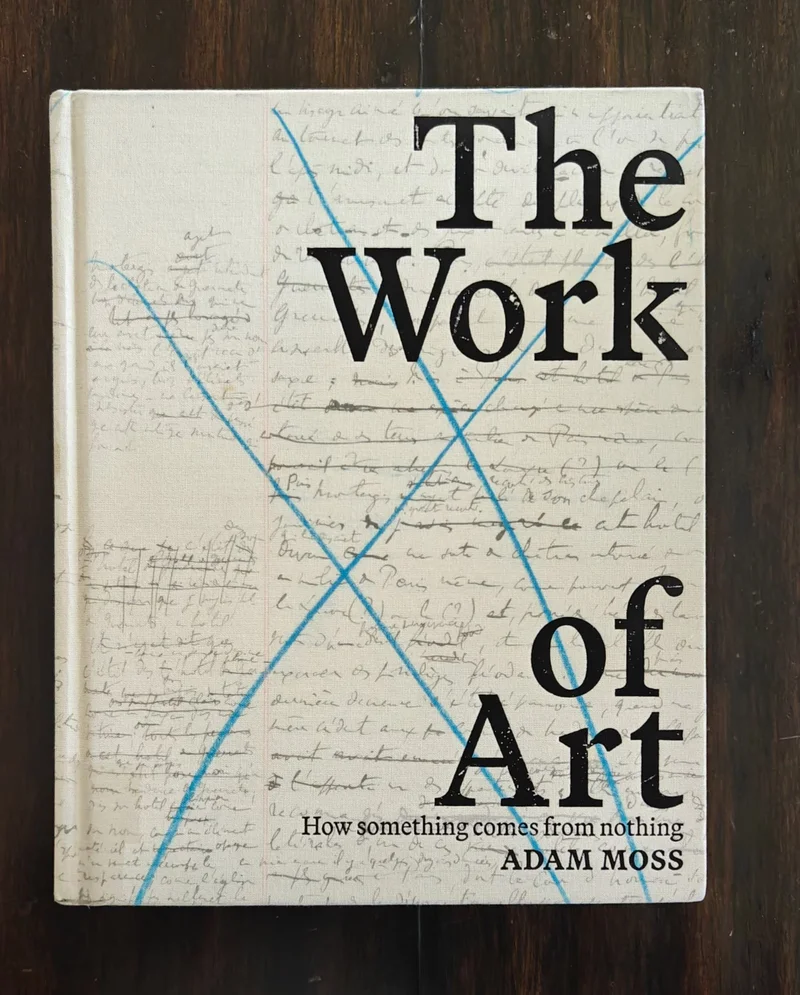
So I went to the library and grabbed "The Work of Art" by Adam Moss.
I had a small, selfish goal: prove there's still something AI can't touch.
It didn't.
At least not how I expected.
The book breaks a myth. Art isn't lightning. Not genius. Not a clean, perfect first try.
It's slower.
Messier.
Try. Fail. Adjust. Repeat.
Again .Again.Again.
Moss interviewed filmmakers, painters, musicians. Same pattern everywhere. Failure isn't a detour—it's the road.
Reminded me of Japanese craftsmen. Patient. Obsessive. One tiny improvement at a time.
And that's when my nice little question turned around and bit me.
I came in asking: Can AI make art?
I wanted "NO!" Capital letters. Exclamation points.
But if art is just trial + refinement… process.
Then in theory — yeah, AI can make art.
The recipe is copyable.
• Generate a million drafts.
• Throw out the bad ones
• Loop: draft → critique → revise
A million times. A billion.
So yes, structurally, AI can make art.
That sentence sits there.
Uncomfortable.
But something still feels off.
Because process isn't enough.
At some point, someone has to decide:
This one stays, that one goes.
That's where it getst messy:
• Taste — why this works, why that sucks
• Intention — what are you even trying to say?
• Experience — a whole life of memories, culture, heartbreak, inside jokes
You can't really code those. Or at least, nobody has yet.
And yet, those are exactly what steer the whole ship. Iteration without direction is just noise.
---
Then the deeper question:
Can AI originate art?
Moss's subtitle is "How Something Comes from Nothing."
But for humans, "nothing" is never actually nothing. It's stuffed with:
• memories
• culture
• odd obsessions
• that time you cried at sunset for no reason
AI's starting point is… different.
• training data
• objectives
• math
Sure, modern models contain the compressed fingerprint of human knowledge. But that might also be the ceiling.
Because everything AI makes is, in some way, derived.
Not lived.
---
So where does that leave us?
My current answer (subject to change next week):
AI can copy the process of making art.
But it doesn't really have a reason to make it.
It can make things that look like art.
Sometimes even feel like art.
But meaning?
That still feels… borrowed.
---
And here's the part that lingers:
What if I'm just defining "art" in a way that keeps humans on top? Like a referee who also coaches one team?
What if AI eventually develops something that resembles intention?
Or worse, what if we start adapting to AI's taste? The same way we adapt to each other's?
Maybe the boundary won't break.
Maybe it just… blurs.
I'm not sure anymore.
But maybe that's the point.
Because if “The Work of Art" taught me anything, it's this:
Nothing meaningful arrives fully formed.
Not art.
Not answers.
Only the process.
And we're still in it.